
Shaxi Ancient Town lies north of Dali Old Town. Although the distance does not look far on a map, most journeys take around two to three hours by road because the route gradually enters more mountainous terrain.
There is no railway station or airport in Shaxi, so the final part of the journey must be completed by road. You can travel by tourist bus, shared car, private transfer, public transport via Jianchuan or self-drive.
For one or two travelers with limited luggage, a tourist bus or shared car is usually sufficient. A private transfer is more practical for families, small groups, travelers with several suitcases or anyone continuing from Shaxi to Lijiang.
Dali to Shaxi at a Glance
| Option | Typical travel time | Best suited to | Main limitation |
|---|---|---|---|
| Tourist bus | About 2.5 to 3 hours | Solo travelers and couples | Schedules and pickup points may change |
| Shared car | About 2 to 3 hours | One or two travelers | Pickup time and luggage space vary |
| Private transfer | About 2 to 3 hours | Families, groups and travelers with luggage | Higher cost |
| Via Jianchuan | Longer and less predictable | Experienced, budget-focused travelers | Requires a transfer |
| Self-driving | About 2 to 3 hours | Travelers licensed to drive in China | Mountain roads, permits and parking |
Transport schedules and prices can change, so confirm the current details with your accommodation, booking platform or transport provider before departure.
How Far Is Shaxi from Dali?
The actual driving distance depends on the route and your starting point in Dali. A pickup from Dali Old Town is different from a departure from Xiaguan, Shuanglang or another village around Erhai Lake. The road also becomes more winding as it approaches Jianchuan and the Shaxi Valley.
In most cases, I suggest allowing two to three hours rather than planning around the fastest possible driving time. This leaves some room for traffic, road conditions and collecting passengers.
When arranging transport, give the driver your exact hotel address instead of simply saying “Dali.”
Taking a Tourist Bus from Dali to Shaxi
Tourist buses may operate directly between Dali and Shaxi, making them one of the easiest budget options when the schedule suits your plans.
Services may leave from Dali Old Town or designated tourist pickup points. Departure locations, fares and operating times can change, so old timetables found online should not be treated as permanent. A direct journey normally takes around 2.5 to 3 hours.
When the bus makes sense
A tourist bus is a reasonable choice when you are traveling alone or as a couple, have manageable luggage and do not mind leaving at a fixed time. It also avoids the uncertainty of changing vehicles in Jianchuan.
What to check before booking
Confirm the exact departure point, latest check-in time, luggage allowance, arrival point in Shaxi and whether the service operates on your travel date.
Arrive at least 20 minutes early. When booking, make sure the destination is Shaxi Ancient Town in Jianchuan County, as similarly named places can appear in Chinese booking systems.
Traveling by Shared Car
Shared cars can be arranged through hotels, guesthouses, local drivers or Chinese booking platforms.
This option is more direct than changing public transport, and some services collect passengers near their accommodation. However, the quoted pickup time may not be the actual departure time because the driver often needs to collect several passengers from different locations. Once everyone is on board, the journey normally takes around two to three hours.
Why travelers choose a shared car
A shared car can offer a useful balance between price and convenience, particularly for one or two travelers who want a direct journey without paying for an entire vehicle.
Questions to ask before confirming
- Is the price per person or per vehicle?
- Is hotel pickup included, and will other passengers be collected?
- Does the vehicle have enough luggage space?
- Are multiple destinations or drop-off stops planned?
- Is the final drop-off point near your Shaxi accommodation?
Vehicle quality, seating and luggage capacity are not standardized. If you have several large suitcases, send the provider a photo or clear description of the luggage before paying.
Booking a Private Transfer
A private transfer is the simplest option if you are traveling with children, carrying several suitcases or following a fixed itinerary.
The driver can collect you from your accommodation in Dali and take you directly to Shaxi. Parts of Shaxi’s historic centre are pedestrianised, so the vehicle may need to stop at the nearest accessible road rather than directly outside your guesthouse.
Why a private transfer can be worthwhile
You can choose the departure time, avoid collecting other passengers and use a vehicle that matches your group and luggage. A private transfer also makes more sense when Shaxi is part of a longer route:
Dali → Shaxi (overnight) → Shibao Mountain → Lijiang
In this case, the road journey becomes part of the itinerary rather than a separate transport problem.
Possible stops between Dali and Shaxi
Depending on where you start and what you have already visited, the route may include Xizhou, Zhoucheng, Jianchuan and villages in the Shaxi Valley.
Shibao Mountain is another possibility, but I normally prefer to visit it on the morning after an overnight stay in Shaxi. Trying to combine too many stops with the transfer from Dali can make the day feel rushed.
Joy’s planning note
I grew up in Yunnan, and one planning mistake I often see is treating road-transfer days as empty spaces that need to be filled with more attractions.
The journey from Dali to Shaxi already involves changing landscapes and increasingly rural surroundings. One or two meaningful stops are usually better than turning the drive into a checklist.
Traveling with children, luggage or a fixed schedule? Hidden China Travel can arrange a private transfer from your Dali accommodation to Shaxi, followed by onward travel to Lijiang.
Ask Joy About a Private Transfer
Traveling via Jianchuan
It may be possible to travel from Dali or Xiaguan to Jianchuan County and then transfer to local transport for Shaxi. The route generally follows this pattern:
Dali or Xiaguan → Jianchuan → Shaxi
This option is better suited to experienced independent travelers who speak some Chinese and are comfortable navigating local bus stations.
Current schedules and connection details can be difficult to confirm through English-language sources. The final service from Jianchuan may also operate differently from a fixed tourist bus.
Although this route may reduce the transport cost, the saving may not justify the additional time, luggage handling and uncertainty for many international visitors. A direct bus or shared car normally provides a better balance.
Driving from Dali to Shaxi
Self-driving provides flexibility, but international visitors must first confirm that they are legally permitted to drive in China.
A foreign driving licence or International Driving Permit alone does not normally authorize someone to drive in China. Short-term visitors generally need to obtain a Chinese temporary driving permit before driving a rental vehicle. The application commonly requires a passport, valid foreign driving licence and an accepted Chinese translation.
Before renting a car, confirm that:
- Your temporary driving permit is valid.
- The rental vehicle is legally registered and insured.
- Your navigation app works in China.
- Your accommodation has provided parking instructions.
- You are comfortable driving on winding mountain roads.
The main route is paved, but the final sections contain frequent bends. Avoid following navigation shortcuts onto narrow rural roads simply because they appear slightly shorter.
Parts of Shaxi’s historic centre are pedestrianised. Park at the location recommended by your accommodation and continue on foot.
Which Option Should You Choose?
Choose the tourist bus if you are traveling alone or as a couple, have limited luggage and can work around a fixed departure time.
Choose a shared car if you want a direct journey and some pickup flexibility, but do not need complete control over the schedule.
Choose a private transfer if you are traveling with children, carrying several suitcases, traveling as a group or continuing from Shaxi to Lijiang.
Travel via Jianchuan only if keeping the cost low is more important than convenience and you are comfortable navigating local transport in Chinese.
Choose self-driving only if you have the required Chinese driving permit and experience driving on mountain roads.
Where Will You Be Dropped Off in Shaxi?
Most vehicles stop near the edge of the historic town rather than directly on Sideng Square.
The old lanes are narrow and partly pedestrianised, and uneven stone paving can be difficult with a large wheeled suitcase. Some guesthouses may help with luggage or arrange a small local vehicle, but this should be confirmed in advance.
Before leaving Dali, send your Shaxi accommodation your estimated arrival time, vehicle type, driver's phone number and number and size of suitcases.
Ask for the exact Chinese name or map pin of the recommended drop-off point. This helps avoid confusion between the visitor centre, a parking area and the nearest entrance to your accommodation.
Should You Stay Overnight in Shaxi?
You can walk through Shaxi’s historic centre in several hours, but I recommend staying for one night if your itinerary allows it.
Shaxi is not a destination that becomes more rewarding simply by adding more attractions. Its appeal lies in its pace.
After many daytime visitors leave, Sideng Square and the surrounding lanes become quieter. An evening walk through the old town, followed by an unhurried morning, feels very different from stopping for lunch between Dali and Lijiang.
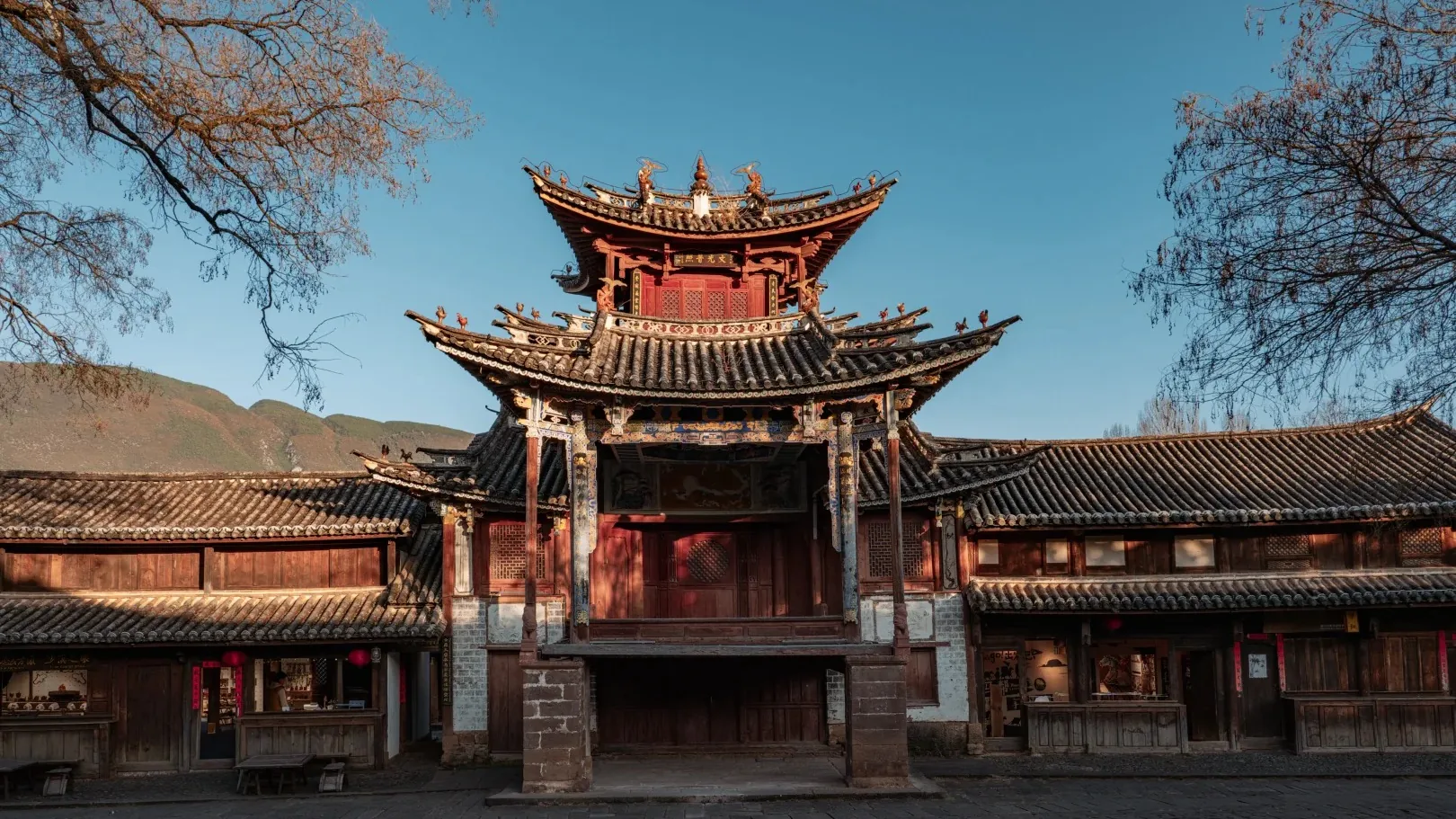
With one night, you have time to walk through Sideng Square, see the old theatre stage and Xingjiao Temple area, visit Yujin Bridge in the late afternoon, experience the town after its busiest hours and visit Shibao Mountain the following morning before continuing to Lijiang.
Shaxi contains one of the most complete surviving market areas associated with the historic Tea and Horse Caravan Trail.
Joy’s planning note
I include Shaxi in the six-day route because it creates a pause between Dali and Lijiang. The value is not the number of sights inside the town. It is the change of pace between two busier destinations.
If you stop only for a short midday visit, you will see the historic buildings but may miss the reason many travelers remember Shaxi.
For accommodation, seasonal advice and places to explore, read the Shaxi Ancient Town Travel Guide.
Continuing from Shaxi to Lijiang
Shaxi sits naturally between Dali and Lijiang, which makes an overnight stay more logical than returning to Dali.
A practical sequence is:
Dali → Shaxi → Shibao Mountain → Lijiang
I recommend allowing around 1.5 to 2.5 hours in practice for pickup, road conditions, traffic entering Lijiang and delivery to your accommodation.
Shared cars and private transfers may be available. Confirm the pickup point because larger vehicles may need to collect passengers outside the pedestrian section of the old town.
If you want to visit Shibao Mountain before continuing to Lijiang, a private vehicle makes the timing and luggage arrangements considerably easier.
Including Shaxi in a Private Yunnan Journey
Shaxi works best as part of a continuous route rather than as an isolated day trip.
Our six-day private Yunnan journey follows:
Kunming → Dali → Shaxi → Lijiang
The journey includes two nights in Dali, one night in Shaxi and two nights in Lijiang, with private road transport, Shibao Mountain and a full day at Jade Dragon Snow Mountain. The route avoids returning to Dali and allows Shaxi to provide a genuine contrast to the busier old towns.
View the 6-Day Private Yunnan Journey
Already have your own itinerary? Ask Joy to Arrange Your Transfers
About the author
Joy Liu was born and raised in Yunnan and spent years living and travelling abroad. Joy founded Hidden China Travel to help international visitors plan private Yunnan journeys with clearer local guidance and fewer practical uncertainties.
Last reviewed: November 2026. Transport schedules and prices should be confirmed before travel.